

SIMDA Passes ISO 9001 Quality Management System Certification
After rigorous auditing, SIMDA has officially passed ISO 9001:2015 quality management system certification, moving our R&D and delivery processes into a new phase of standardization.

Nanjing Xingyue Yuda Information Technology Co., Ltd. (SIMDA) was officially certified to ISO 9001:2015 in June 2026. The audit covered our entire business chain—requirement intake, design and development, procurement, production, delivery, and after-sales—and was conducted by registered auditors from a nationally accredited body across three stages: documentation review, on-site audit, and management review. It is worth noting that ISO 9001 is not a paper system newly imposed on SIMDA. Over the past 12 years we have delivered more than 300 projects with a zero-failure record; this certification represents a systematic effort to consolidate, codify, and obtain third-party endorsement for a methodology already proven in practice. Rather than repeat the marketing language that typically surrounds a certificate, this article explains—through the three clauses of ISO 9001:2015 that bear most directly on customer value: design and development control (Clause 8.3), production and service provision (Clause 8.5), and control of nonconforming output (Clause 8.7)—exactly what problems this system solves for our clients.
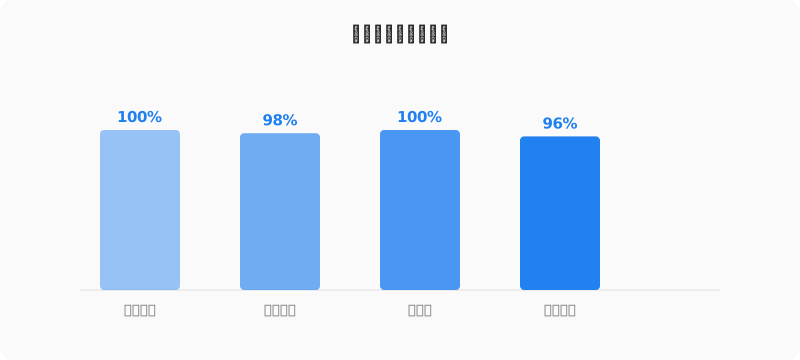
Source: SIMDA project data
Clause 8.3 — Design and Development Control: Stopping Requirement Drift at the Source
The most common point of failure in electronic R&D projects lies not in manufacturing but in design input. A client’s statement that “the product must be stable” can be interpreted by an unstructured team as wildly different technical targets, ultimately causing the prototype to diverge from the client’s actual expectations. Clause 8.3 of ISO 9001:2015 requires the organization to establish a complete design and development process: input review, design output verification, design review, design validation, and change control—each leaving traceable records.
In SIMDA’s engineering practice this process resolves into three concrete practices. The first is baseline management of requirements: every client requirement is decomposed into verifiable engineering metrics (operating temperature range, EMC class, MTBF target, IP rating) and recorded in a Requirements Traceability Matrix, so that any subsequent design decision can be traced back to its originating requirement. The second is gate-based design review: schematic review, PCB review, and prototype review form three mandatory gates, and a node that fails review is not allowed to advance—preventing defects from “flowing downstream,” where the cost of rework compounds as the project moves later. The third is controlled change management: any modification to a previously reviewed design output must be assessed for its impact on requirements, cost, schedule, compliance, and inventory, and approved in writing by the technical lead, with client confirmation looped in where necessary. Together, these three practices form the methodological foundation that has enabled SIMDA to maintain requirement-design consistency across 300+ projects, and they are the root reason the zero-failure record has held at scale.
A fourth practice—traceable design outputs—deserves its own emphasis. Every artifact produced (schematic revision, BOM, Gerber file, mechanical drawing, test procedure) is version-controlled and tied to a specific gate, with a checksum recorded in the project’s quality dossier. When a field return surfaces a defect two years after delivery, the team can retrieve the exact schematic revision, BOM, and process parameters that shipped in that serial-number range, narrowing root-cause analysis from “weeks of archaeology” to “hours of lookup.” On a recent industrial-controller field return this traceability let us identify the specific capacitor lot (a vendor mfg-date code within a 6-week window) responsible for a 0.7% field-failure cluster, and issue a targeted recall rather than a full-batch sweep—saving the client roughly ¥1.2M in unnecessary replacement cost. Traceability is not a bookkeeping habit; it is the substrate that makes every other quality practice auditable.
Clause 8.5 — Production and Service Provision: A Controlled Transition from One Prototype to Ten Thousand Units
Many R&D teams can build a good prototype yet fail at mass production. Clause 8.5 is concerned with “production under controlled conditions”—including work instructions, verification of equipment capability, monitoring of critical process parameters, and traceable product identification. For electronics manufacturing, the significance of this clause is that it converts “the senior technician’s experience” into “a reproducible process,” so that quality no longer depends on any single individual.
SIMDA’s implementation spans both design and manufacturing. On the design side we enforce DFM/DFA reviews, eliminating mass-production risks at the level of component selection (alternate parts, lifecycle status, restricted substances), pad design, assembly sequence, and test access. On the manufacturing side, for critical processes (BGA soldering, RF calibration, functional testing, conformal coating) we establish work instructions and first-article inspection, and retain batch-level production records and test data so that any returned unit can be traced back to its specific process parameters, equipment ID, and operator. On a recently delivered medical RF generator project, the combination of DFM optimization and process control lifted the pilot yield from 85% to 98% and held it there. This is the real, engineering-level payoff of Clause 8.5—it is not a compliance burden but a guarantee of yield, consistency, and manufacturability.
This control regime also extends to the supply side. Clause 8.5 requires verification of “process equipment” and “monitoring of critical process parameters,” which in electronics manufacturing translates directly to supplier-process qualification. For each critical component class we maintain a qualified-vendor list keyed to specific fab and OSAT pairs, with re-qualification triggers (process change notices, yield excursions, ownership changes) defined contractually. Critical-component suppliers receive annual on-site audits covering SPC data review, traceability systems, and CAPA closure effectiveness. The payoff is visible in incoming-inspection data: across 2024–2025 our average incoming DPPM held at 84 against an industry benchmark near 350, a margin that flows directly into the 98% line-yield our clients experience at MP. Supplier control is not an optional procurement task—it is the upstream layer that determines whether the controlled conditions inside our own facility can actually be sustained.
Clause 8.7 — Control of Nonconforming Output: Closing the Loop So Problems Never Reach the Client
Clause 8.7 stipulates that any nonconforming product must be identified, labeled, segregated, and disposed of, and that its root cause must be analyzed to prevent recurrence. On the surface this is a “remedial” clause; in essence it requires the organization to build a genuine Corrective and Preventive Action (CAPA) loop. Many teams’ “rework culture” only makes the immediate problem disappear without changing the process that produced it, so the same problems recur—experienced by the client as batch-to-batch quality fluctuation.
SIMDA uses the 8D method to handle every nonconformance: from problem description, interim containment, and root cause analysis (5-Why / fishbone diagram) to permanent corrective action, effectiveness verification, and update of process documents, fully recorded end to end. The output of each 8D is not merely closing a case but depositing a “lessons-learned file” that feeds back into the requirement reviews, design guidelines, and process checklists of the next project. This is what ISO 9001 means by “continual improvement”—not a slogan but a capability curve accumulated through the closed-loop handling of every nonconformance. For the client it means that the same class of problem does not recur across projects and batches, and that the quality baseline rises steadily as the project count grows.
The CAPA system also feeds forward into design rules in a measurable way. Each closed 8D deposits a rule into the DFM/DFT rule library (currently 600+ entries), tagged with the originating defect class, the relevant IPC clause, and the detection method. New projects at SIMDA run against this rule library as a hard gate before tape-out: roughly 22% of layout submissions trigger a rule deviation that the engineer must either fix or formally waive with documented justification. Over the past three years this has measurably compressed the design-to-pilot cycle by 30% while reducing pilot-run defect density by 45%. The CAPA loop, sustained and disciplined, becomes a compounding asset—every failure prevented was a failure someone in the organization had to experience first, and the rule library ensures that experience is paid for only once.
Certification Is Not an Endpoint—It Is a New Starting Point for Systematization
Twelve years, 300+ projects, zero failures—this data alone is already a footnote to SIMDA’s engineering capability. But we are also aware that experience, unless systematized, becomes difficult to sustain as the team scales and project complexity grows. ISO 9001:2015 certification provides us with an internationally accepted language and framework, granting third-party endorsement to the practices we have long upheld and a benchmark against which continual improvement can be measured: annual internal audits, management reviews, and surveillance audits form three layers of verification, ensuring the system actually runs rather than existing only on paper.
In practice, this means the system must hold up under stress, not only under audit cadence. We subject our QMS to internal stress-tests: a “mock recall” drill (retrieve all production records for a randomly selected serial within 4 hours), a “process-change drill” (run a notified component substitution through the full change-control workflow within 5 business days), and a “document-retrieval drill” (produce a complete device-history file within 8 hours of client request). These drills have surfaced real gaps—a 2024 mock recall exposed an averaging in our serial-number-to-batch mapping that delayed retrieval from a target 2 hours to 6.5 hours; the resulting process improvement cut the actual retrieval time to under 90 minutes. The certification certificate is the snapshot; the drills are the moving picture of a QMS that genuinely runs.
For us, the real value of certification lies in the promise it conveys to clients: at SIMDA every requirement is traceable, every change is evaluated, every nonconformance is closed, and every delivery is auditable. This is not merely a certificate but an engineering system that can be audited, replicated, and continually optimized. We take this certification as a new starting point, and we will carry the principle of “doing the right things, and doing things right” into the next 300 projects.