

Localized Substitution: The Next Decade of the Electronics Supply Chain
Against the backdrop of global supply-chain restructuring, component localization has shifted from "optional" to "mandatory." This article breaks down the substitution path, risks, and landing strategy.

Over the past three years, the global electronics supply chain has weathered three distinct shocks: the 2021–2022 semiconductor shortage, the 2023 inventory correction, and the sustained escalation of geopolitical export controls through 2024–2025. For Chinese R&D teams, the consequence is structural. According to cross-referenced data from the China Semiconductor Industry Association and third-party research firms, domestic MCU vendors captured 35% of the China market in 2025—nearly double their 17% share in 2020. Localization rates at mature process nodes of 28nm and above now exceed 40%. Substitution is no longer a public-relations slogan; it is an engineering task written into the second line of every bill of materials.
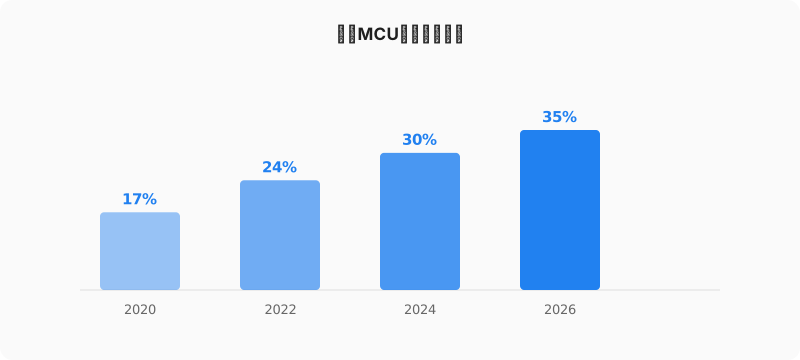
Source: SIMDA project data
The Essence of Substitution: Beyond Pin-to-Pin
Many teams reduce localization to “finding a domestic pin-compatible part.” That is the lowest layer of substitution. Genuine engineering replacement must penetrate three dimensions.
The first is electrical consistency. Take a 32-bit MCU: two parts sharing the same ARM Cortex-M4 core can differ in flash wait states, ADC signal-to-noise ratio (typically by 2–3 dB), IO drive current, and power-up sequencing. These deltas are invisible at room temperature but trigger intermittent failures across the -40°C to +85°C industrial range—symptomized by sporadic resets, communication bit errors, or sampling jumps.
The second is process and yield. Domestic 28nm MCUs in yield-ramp phases often show weaker batch-to-batch consistency than imported parts that have been in mass production for five or more years. Engineers should introduce batch sampling during DVT—we recommend no fewer than 3 lots, 30 units per lot—paired with high-temperature burn-in to evaluate early-failure rates and parameter drift.
The third is ecosystem maturity, frequently the most underestimated cost line. Imported MCUs benefit from a decade or more of HAL libraries, IDE plug-ins, reference designs, and third-party stacks (FreeRTOS, lwIP, Modbus, CANOpen). Domestic MCUs are supported by ARM CMSIS or RISC-V SDKs, but engineers routinely fill gaps at the edges—USB host, Ethernet PHY adaptation, secure boot, TrustZone-M. This hidden R&D investment often exceeds the component price delta itself.
Beyond these three dimensions, substitution verification demands a quantitative reliability baseline. JEDEC JESD22-A108 defines the high-temperature operating life (HTOL) test that biases parts at 125°C for 1000 hours, accelerated by an Arrhenius model with activation energy typically 0.7 eV—roughly equivalent to 10 years of field life at a 55°C junction. For each candidate domestic part we track ΔVth, ΔIcc, and parametric drift on critical analog specs (ADC offset, bandgap reference) against pre-stress baselines, flagging any sample that shifts beyond ±3σ of the imported incumbent’s distribution. Without this statistical anchor, a “pin-compatible” part can pass functional tests at DVT yet drift 6–8% over the product’s qualified life—a defect class that surfaces only in field returns and warranty claims.
The Rise and Boundary of Domestic MCUs
Over the past five years, Chinese MCUs have crossed from “usable” to “good” in the mid-to-low segment. In 32-bit general-purpose control, motor drive, and consumer main-control applications, domestic solutions based on Cortex-M0+/M3/M4 have achieved scaled replacement. Vendors such as GigaDevice (GD32), HDSC (HC32), and MindMotion (MM32) now ship at the hundred-million-unit scale across consumer and industrial markets, while domestic RISC-V cores (T-Head XuanTie, StarFive) are opening a wedge in low-cost, customizable applications.
But in the high end, clear ceilings remain:
- High-performance MCUs: Domestic solutions for automotive ASIL-D, heterogeneous multi-core Cortex-M7+M33, and frequencies above 400MHz are still catching up, with limited production cases.
- Analog and mixed-signal: Domestic substitution rates for high-precision ADCs (16-bit and above, ENOB ≥ 14), low-noise LDOs, and high-speed DACs remain below 20%—persistent bottlenecks in the BOM.
- RF and connectivity: Wi-Fi 6/6E, 5G RedCap, and millimeter-wave radar chips trail their digital counterparts by two to three years.
Industry data underscores where the gap is widest. IC Insights estimates China’s domestic IC self-sufficiency rate at 23% in 2025, projected to reach roughly 35% by 2030—but this headline number masks sharp divergence by category: logic and MCU substitution sits near 40% while analog ICs remain below 18% and high-speed RF below 12%. In automotive, only a handful of domestic MCUs have cleared full AEC-Q100 Grade 1 qualification (−40°C to +125°C, process node 0.11µm or finer) with documented PPAP submissions, and ASIL-B/D-grade parts are essentially absent from volume supply. The practical implication is that localization roadmaps must be tiered by criticality: commodity control MCUs can be swapped inside one design cycle, while analog signal chains, isolation, and automotive-grade parts require a 24–36 month parallel-qualification effort with sustained FAE engagement from the silicon vendor.
This means the next three years of localization will shift from “general MCU swap” to three high-barrier domains: high-precision analog, RF, and automotive-grade.
A Three-Layer Risk Assessment Model
In SIMDA’s engineering practice, every BOM line is scored through a three-layer model that drives substitution priority, avoiding instinct-driven selection:
- Functional risk: Does the part affect core product function or certification (CE/FCC/CCC, or automotive AEC-Q100)? High-risk items enter the priority queue.
- Supply-chain risk: Is the vendor on an export-control list? Is there single-country, single-fab, or single-OSAT dependency? Does standard lead time exceed 26 weeks?
- Technical risk: Is there a domestic pin-to-pin or parametric alternative? Is the toolchain compatible with the existing codebase? Are there public production precedents?
After layered screening, a typical 100-line-item board of moderate complexity usually yields 30%–40% of parts ready for immediate substitution, about 20% requiring peripheral circuit redesign, and the remaining 40% still difficult to replace within 12–18 months.
To make the model actionable, we convert each dimension into a 1–10 score and compute a Risk Priority Number (RPN = F × S × T), adapted from FMEA methodology. Line items scoring above RPN 200 enter the immediate-action queue; items between 100 and 200 enter a 12-month plan; below 100 are monitored quarterly. This converts an otherwise political “substitution quota” discussion into an engineering trade study with traceable assumptions. On a recent industrial-gateway program the model surfaced 14 high-RPN line items that the original BOM owner had deprioritized—among them a single-source Japanese real-time clock whose fab sat in an export-restricted region. Catching that risk at schematic review, rather than at the export-control checkpoint four months later, preserved the schedule buffer and avoided a forced redesign under duress.
A Methodology for Volume-Production Substitution
Substitution verification is not a one-time experiment but a methodology spanning design, validation, and production:
- Dual-track prototyping: Fabricate the original (Revision A) and substitute (Revision B) designs in parallel and run cross-tests, with emphasis on temperature drift (-40/+25/+85°C), EMC (per EN 55032 Class B radiated and conducted), and ESD (HBM ±8kV / CDM ±500V).
- Accelerated aging: Subject critical substituted parts to 1000 hours of high-temperature/high-humidity stress (85°C / 85% RH, the HTHHR/HAST profile) to evaluate solder-interface integrity and long-term reliability.
- Protocol conformance: For communication devices (CAN, RS-485, Modbus, MQTT gateways), retest bit-error rates under bus congestion, noise injection, and long-cable (>100m) conditions—not just connectivity.
- Supply penetration: Do not stop at the distributor—sign a Product Lifecycle (PLC) commitment directly with the original manufacturer, and require disclosure of fab and OSAT partners to hedge against “second-source gap” risk.
Statistical confidence closes the loop. For each substituted line item we apply an LTPD (Lot Tolerance Percent Defective) plan per ANSI/ASQ Z1.4 with AQL 0.65 for critical parameters—requiring sample sizes of 80–125 units per lot at General Inspection Level II. Early-failure data is fitted to a Weibull distribution (β < 1 indicates infant mortality, β ≈ 1 random failure, β > 1 wear-out); only when β ≥ 0.9 and the MTTF at the 90% lower confidence bound exceeds the product’s qualified life do we sign off. On one BMS monitor board this discipline caught a domestic LDO whose bench tests passed cleanly but whose Weibull fit (β = 0.6) indicated a 3.2% first-year infant-mortality rate—unacceptable in a 10-year-life industrial asset, even though the part had cleared every parametric datasheet entry. The methodology converts “looks fine on the bench” into “statistically defensible for volume.”
Conclusion and Recommendations
Localization is a decade-scale industrial restructuring. For front-line engineers, it is both a challenge and an opportunity to deepen team expertise. We offer three concrete recommendations.
First, write substitution verification into the standard R&D process, embedded in gate reviews, rather than treated as emergency firefighting. Second, build an internal substitute-parts database to sediment test reports, lessons learned, and revision changes from each replacement, preventing knowledge attrition. Third, establish a direct technical line to the original manufacturer, bypassing distributor layers to obtain FAE support—a decisive advantage when troubleshooting hard issues.
The macro backdrop rewards this discipline. MIIT’s 2024 “Special Action Plan for Basic Electronic Components” sets a 70% domestic-content target for industrial-grade MCUs and analog chips by 2027—meaning BOM-level localization will move from “recommended practice” to “procurement requirement” on government-linked tenders within two design cycles. Teams that build the substitute-parts database and dual-track verification muscle now will inherit that market; those that wait will be reacting to compliance deadlines under schedule pressure, the most expensive way to absorb a structural change. Internally, this also argues for a dedicated component-engineering role—a common omission in Chinese R&D orgs—whose remit spans qualification testing, lifecycle monitoring, and supply intelligence.
Over the past 12 years, SIMDA has completed substitution verification across 1000+ part numbers—covering the full ARM Cortex-M family, RISC-V, analog front-ends, and power management—sedimenting an evaluation model that spans electrical compatibility, production stability, and long-term supply. If your project is planning a localization roadmap, our engineering team welcomes the conversation.